
Friday, December 22


Contemporary Islamic Terrorism The roots of international Islamic terrorism can be found at first glance in the war in Afghanistan in the 1980's, a proxy war fought during the height of the Cold War. The Afghan mujahideen fought their holy war — jihad — with the help of the Wahhabi regime in Saudi Arabia and with the help of Pakistan. U.S. support was crucial during the war where the American services and most importantly the C.I.A. managed to promote the fighting capabilities of the "holy warriors" by transferring via Pakistan the necessary logistical and armament support. Over 40,000 mujahideen, gathered from Muslim states around the globe, fought in this war and some of them ultimately provided the human resources base for the terrorist organizations of the 1990's. World Press Org
Iraq 'Fatally Weakened': Report Iraq today is "hollowed out and fatally weakened" and "prey to armed militias, sectarian forces and a [self-serving] political class," according to a study released this week by the Brussels-based independent think-tank the International Crisis Group (I.C.G.). World Press Org
Thursday, November 30

The Turkish train crash MELANCHOLY is Istanbul's defining characteristic, writes Orhan Pamuk, Turkey's Nobel prize-winning novelist. And melancholy has now descended on the country's relationship with Europe. “Almost everyone I know has lost heart,” says Soli Ozel, a political scientist at Istanbul's Bilgi University who wants Turkey to join the European Union.
... It was always going to be difficult to get Turkey into the EU. On top of complications arising from its poverty, its mostly Muslim culture and its mistreatment of the Kurds, it would be the largest member, with the most votes in the Council of Ministers and the most seats in the European Parliament. Even so, the accession talks have been unnecessarily fraught.
... All this suggests that the quarrel is to do as much with the Europeans as with the Turks. In 2005 European political leaders agreed to negotiate Turkish accession in good faith, but it is not clear that all are doing so. Unwilling to admit that they want to keep Turkey out, France, Austria and Cyprus are making demands that seem designed to induce the Turks to walk away.
... For the EU, a rejection of Turkish membership would represent a huge lost opportunity. Europe's foreign policy, and its hopes of global significance, would suffer a catastrophic loss of credibility if it were seen to be blackballing a moderate Muslim country that has NATO's second-largest army. The EU's reputation in the Muslim world, which is watching the membership talks with Turkey closely, would sink, perhaps even below America's. Economist

Blood, tears and still no victory GEORGE BUSH returned to the Middle East this week a diminished figure. At home he has been thumped by the voters. In Iraq his dreams of an example-setting democracy have trickled away in blood. For all the brave words he exchanged with Iraq's prime minister, Nuri al-Maliki, in Amman at mid-week, it is widely assumed that his real aim now is simply to arrange a way for America to leave Iraq as soon as it decently can. Only then would the Republicans have a chance of retaining the White House in 2008. And only after it has left Iraq will America be able to restore its tattered influence in the wider Middle East.
Such, at any rate, is the conventional wisdom. But is it correct? And did anyone tell Mr Bush? The president certainly faces a daunting array of problems in the region. In this special section we look at four of them: actual civil war in Iraq, potential civil war in Lebanon, the stalemate in Palestine and the hostility of an Iran that seems intent on acquiring nuclear weapons. And yet despite all that has gone wrong in Iraq, America remains by far the strongest external power in the Middle East—and for the next two years Mr Bush will remain its president.
On his way to Amman, Mr Bush did not talk as if he felt like a weakling. He insisted at a NATO summit in Riga that American troops would not leave the battlefield until the mission in Iraq was complete. And after meeting Mr Maliki in Amman, he promised again that the troops would stay just as long as Iraq's government wanted them to. Liberty had to prevail in the Middle East, the president declaimed, “and that's why this business about graceful exit simply has no realism to it at all.”
Realism is in the eye of the beholder. The fact that Mr Bush met Mr Maliki in Jordan's capital rather than in Baghdad highlights how anarchic Iraq has become. Most of Iraq's politicians claim to want the same thing America wants: a united, non-sectarian state and an end to the violence that has killed tens of thousands in the past year alone. But with a diffuse network of Sunni guerrillas pitted against equally disorganised Shia militias, nobody has the authority to deliver. The governments that are party to the conflict, in Iraq and beyond, are several steps removed from the actual killing: all they can do is to cajole others to cajole the armed groups.
Mr Maliki succeeded in pressing Mr Bush to allow more Iraqi soldiers to come under his direct control. At present most of them answer to the American chain of command. But this will not have a huge impact on the ground. Building up the Iraqi army, which suffers badly from ill-discipline and sectarian tensions but still appears to respond, more or less, to the prime minister's orders, is taking time. “It's not easy for a military to evolve from ground zero,” Mr Bush conceded.
Another basic problem is the domestic political weakness of Mr Maliki. After their meeting, Mr Bush said that the Shia prime minister was “the right guy” for Iraq and that it was in America's interest to help him. Privately, however, the Americans are increasingly unhappy about supporting a government that does not appear to be making enough effort to restrain Shia militias and reach out to the Sunnis
Behind the scenes, Mr Bush probably tried to encourage Mr Maliki to detach himself from Muqtada al-Sadr, the radical Shia cleric whose followers are believed to be responsible for a large share of the sectarian killing. Mr Maliki, however, needs Mr Sadr, who is one of the few leaders to have any influence over the Shia sectarian gangs, most of which claim association with his Mahdi Army but in practice operate autonomously. The young firebrand does appear to be doing a bit to restrain his more out-of-control followers.
Before the summit, the New York Times published a leaked memo written by Stephen Hadley, Mr Bush's national security adviser, saying of Mr Maliki that he “wanted to be strong but was having difficulty figuring out how to do so”. The memo emphasised Mr Maliki's need to put some distance between himself and Mr Sadr. Mr Sadr is meanwhile putting pressure on Mr Maliki to distance himself from the Americans. After a triple car-bombing in the Mahdi Army's east Baghdad support base of Sadr City killed more than 200 people last week, Sadrist officials said that the Americans were primarily to blame for failing to provide security. They threatened to pull out of the government if Mr Maliki went through with his meeting with Mr Bush, though in the event, the Sadrists merely “suspended participation”, a good step short of a full walk-out.
In Washington, debate is transfixed on the report expected next week from the Iraq Study Group, a bipartisan committee promising sagacious advice on how America can best extract itself from the quagmire (see article). One much-leaked idea is said to be for American talks with Iran and Syria about how they could help calm Iraq, perhaps in the context of a regional peace conference that would touch on Palestine too. But Iran and Syria do not feel they need America's invitation to become involved. Syria established formal ties with Baghdad last week after a break of 25 years. This week, Iraq's president visited Tehran (see article) while Mr Maliki was packing for Amman. Iraq's neighbours have their own interest in limiting the chaos. That does not make them eager to help America. And nor did Mr Bush say anything in Amman to suggest that he is in the market for that “graceful exit”. Economist

Generation Dem The midterm elections of 2006 may be among the most momentous in two generations -- if their trends carry through the 2008 presidential election and beyond. These changes include a Democratic Congress that reflects a more politically cohesive national majority than any previous one; shifts of crucial constituencies that may represent a decisive repudiation of the Republican Party in its current incarnation; and the emergence of a younger generation that is overwhelmingly Democratic Salon
Friday, November 17

Heart-broken victims united in bid for peace Father of captured Israeli consoles Palestinians at hospital In a moving scene of reconciliation and hope, the father of the Israeli soldier whose capture started the current round of fighting in Gaza visited a Tel Aviv hospital Thursday to see Palestinians injured in last week's Israeli bombardment of Beit Hanoun. And two Palestinians whose families were decimated by the attack joined Noam Shalit in offering prayers for peace between Israelis and Palestinians, the recovery of the injured and an end to the holding of his son. SF Gate
Monday, November 13

Neoconservatism -- RIP
The moralistic ideology has utterly failed. But as long as Bush still abides by it, his disastrous "war on terror" will drag on.
Nov. 14, 2006 | The neoconservatives who dreamed up America's Iraq nightmare are rushing desperately about, searching for scapegoats. Their favorite whipping boy is yesterday's jutting-jawed hero, Donald Rumsfeld, who has been unceremoniously tossed onto the scrapheap. But they also blame the National Security Council, Condoleezza Rice, George Tenet, Paul Bremer, Gen. Tommy Franks and George W. Bush himself. The only thing they don't blame is the actual culprit -- neoconservative ideology itself.
The neocon finger-pointing over who lost Iraq, recently showcased in Vanity Fair, obscures the fact that Bush's war was a laboratory in which their doctrine was tested -- and completely failed. This failure was manifested on the ground and confirmed by the midterms. Most Americans don't even know what neoconservatism is, but they know a failure when they see it -- and they decisively rejected it.
Unfortunately, Bush himself and the key figures in his administration continue to cling, with the fervor of true believers, to neoconservative ideology. Bush has taken some potentially positive steps, like dumping Rumsfeld and replacing him with the more pragmatic Robert Gates, and saying he's open to "any idea" on Iraq. And he is now under enormous pressure, not just from Democrats but also from his own party, to implement profound changes in his Middle East policies. But it remains doubtful whether a figure as dogmatic and inflexible as Bush, who regards his "war on terror" as a sacred duty, will be able to change his approach. It is essential that the fundamental failure of neoconservatism be recognized, to prevent more foreign policy debacles like Iraq.
Neoconservatism is a notoriously slippery and hard-to-define term, in part because its definition has shifted as its enemies have changed. The first generation of neoconservatives, including Sen. Henry "Scoop" Jackson, Irving Kristol and Norman Podoretz, were former liberals who believed that America needed to stand up and fight communism. Accusing their former colleagues on the left of going soft, they claimed that America's survival and the fate of the free world required toughness, not compromise. (Kristol defined a neoconservative as a "liberal mugged by reality," which goes a long way to explaining why the ideology gained new adherents after 9/11.) The second generation of neocons, including Robert Kagan, William Kristol and Paul Wolfowitz, continued to believe in American exceptionalism and the virtues of force, but they added an idealistic note: America should not just battle evil but also promote democracies around the world. The "good" they sought, however, was not purely altruistic but inseparably bound up with America's self-interest. They wanted America to exercise "benevolent global hegemony." It was axiomatic that what is good for America is good for the rest of the world.
In 1997, many leading neocons started a pressure group called the Project for the New American Century, which called for America to overthrow Saddam Hussein. A number of PNAC members, including Rumsfeld, Wolfowitz, Elliott Abrams and Richard Perle, went on to hold high positions in or to function as influential advisors to the Bush administration.
One of the reasons the neocons were obsessed with Iraq, as George Packer points out in his brilliant study of the Iraq war, "The Assassins' Gate," is that they "concluded it would be very good for Israel." Many neocon thinkers were closely associated with Israel's right-wing Likud Party; some went on to write a 1996 paper, "A Clean Break: A New Strategy for Securing the Realm," that urged incoming Israeli Prime Minister Benjamin Netanyahu to roll back Syria, work to effect regime change in Iraq, and refuse to return the occupied territories to the Palestinians.
The neocons' attachment to the Israeli right naturally carried with it a whole series of assumptions about the Middle East, about terrorism, about Arabs, about the Palestinians, about Islam, and about how American should conduct its Mideast policy. The neocons, following the eminent pro-Israel Arabist Bernard Lewis, argued that the Arab world had only itself to blame for its backwardness. The Israeli-Palestinian conflict was trotted out by a moribund Arab culture as an excuse. In any case the Palestinians had lost any moral claim because of their recourse to terrorism. America should stop trying to placate the Palestinians and impose a Pax Americana on the region. The Arabs, who respected only force, would fall in line.
Under Bush, these assumptions became U.S. policy -- notwithstanding their significant departure from traditional U.S. Mideast policy, which at least made a pretense of being even-handed. And neoconservative beliefs are enshrined in the Bush administration's "war on terror."
Bush's "war on terror" follows the neocon playbook in every particular. The salient features of that war are these: 1) "Terrorism" is itself the enemy. It is soft-minded and immoral to consider historical context or grievances. Any group that practices terrorism is to be smashed into submission. 2) All militant Islamic groups, from al-Qaida to Hamas and Hezbollah, are essentially the same. They all subscribe to a totalitarian ideology and must be destroyed. 3) Force works. If you smash the Arab world in the mouth hard enough, it will get the idea. If it doesn't, it will be necessary to continue smashing it indefinitely. 4) The Israeli-Palestinian conflict is not that important, and the United States should not interfere with Israel's actions, however harsh. 5) The war on terrorism is so crucial that it merits suspending civil liberties, establishing secret prisons and renditioning suspects to be tortured.
This approach has been a colossal failure on every level. Iraq speaks for itself. The issue that most inflames the Arab-Muslim world against America, the Israeli-Palestinian crisis, is at one of its bleakest moments. The United States is more hated in the region than ever before. Hezbollah emerged stronger after Lebanon's war against it, and its leader, Sayyed Hassan Nasrallah, is the most popular figure in the Arab world. Iran has been greatly empowered. Arab moderates have been marginalized, afraid to be associated with the United States. Arab despots in "moderate" states like Egypt are increasingly threatened by Islamist parties. Afghanistan, which was never properly secured, is falling back into chaos. And as the National Intelligence Estimate pointed out, Bush's Iraq war has greatly increased the number of terrorists.
These are the achievements of the neoconservative approach to Mideast policy. And the problem is not, contrary to neocon claims, simply that Bush failed to properly execute the "war on terror." Well before the Iraq war started, many critics, including this writer, argued that the neocons' good vs. evil worldview was simplistic and dangerous, and that the Bush administration's approach to the Middle East was wrongheaded and if implemented would severely injure U.S. interests. It is no pleasure to be proved right at the cost of America's standing in the world. But as Republican and Democratic policymakers alike try to figure out how to salvage something from the Iraq debacle, it is essential that they also insist on a fundamental reorientation of America's Mideast policies -- and throw neoconservatism into the trash can.
The Bush administration used the shock of 9/11 to convince Americans that radical Islam was evil and that it was our calling to fight it to the death. Bush still believes this. No one disputes that what happened to America that day was terrible, or that terrorism is immoral. But the Iraq war decisively proved that these ethical truisms do not serve as a sufficient basis for foreign policy. You not only have to fight terrorism, you have to fight it smart. But in large part because of their ideological blinders about the Arab world -- dismissal of its grievances, failure to know its history, arrogant assumptions about what it "needed" to develop -- the neocons fought it crudely and stupidly.
The invasion of Iraq was the crowning glory of the neocons' great crusade. Yes, there were some genuine fears about Saddam's WMD, but those were secondary to the Bush administration's desire to smash the pathological Arab-Muslim world in the face (any face would do, and Saddam's was handy) and teach it a lesson it would never forget. Pro-war New York Times pundit Thomas Friedman summed up the neoconservative motivation for invading Iraq succinctly: a "terrorism bubble" had built up in the Arab-Muslim world, and we were going to burst it. Good would triumph and evil would be defeated. Beatings would continue until morale improved. America would show the rest of the world who was boss -- but we would be a benevolent boss, a disappearing boss, installing democracies in the Middle East and then pleasantly fading away to enjoy low oil prices and the glow of knowing that you can do well by doing good. As a bonus, the destruction of Saddam's regime, and the threat to do the same to the other regional evildoers, Syria and Iran, would force the Palestinians, deprived of their backers, to make peace on Israel's terms.
That was the hypothesis -- one that should never have left the ivy-covered walls of Neocon U. When it was field-tested using bullets and bombs in Iraq, not freedom and the triumph of the good but a witches' brew of violence and hatred bubbled up.
And what is likely to be the outcome in Iraq? The best-case scenario may be that we end up with an state run by an unpredictable Shiite strongman like Muqtada al-Sadr, whose rhetoric would be aggressively Islamist, anti-U.S. and pan-Arab but who might be willing to sell us oil. From a realpolitik standpoint, this would arguably be a worse outcome than if the nasty but non-ideological Saddam were still in power. And this is the best-case scenario.
The point is not that the Middle East is a hopeless, primitive mess, where tribal loyalties and the culture of revenge run so deep that it's better to stay away. That kind of Orientalist thinking -- which is now beginning to be heard again from disillusioned neocons on right-wing Web sites -- is too facile. The point is that the Middle East is far more complex in every way than the neoconservatives ever acknowledged. Take "terrorism," that bogeyman of neocon moralists. Both the Iraq mess and Israel's conflict with the Palestinians prove that reifying terrorism as an absolute evil, and basing foreign policy on defeating it without regard to the grievances or historical context out of which it comes, is self-defeating. As everyone who has studied terrorism knows, powerless people turn to terrorism.
In the case of al-Qaida and other jihadists, who have no legitimate grievances, strategic thinking dictates that we take actions to dry up public support for them while employing specifically targeted campaigns against them.
So-called realism, despised by neocons as instrumental and Machiavellian, turns out to be more effective, because more flexible, than the explicitly moralistic ideology of neoconservatism. At some deep level, the American people recognize this. The election was a repudiation, whether fully conscious or not, of lofty moral slogans and hysterical military crusades, and a demand that we take smaller steps. The heady days when neocons David Frum and Richard Perle could issue a book called "An End to Evil" are gone. Americans are at bottom pragmatists, and they now understand that the Middle East is not as black-and-white as Bush and the neocons insisted. Of course there are clear-cut bad guys, like al-Qaida. But the Bush administration's neocon attempt to link al-Qaida to every other militant group in the area we don't like is falling on increasingly deaf ears. It sounds too much like the same grandiose rhetoric used to justify the Iraq disaster.
The American people are not going to sign off on a new war against Iran or commit troops to battle Hezbollah. This isn't "appeasement" -- it's common sense. If the neocons still want to accuse their opponents of being appeasers, as they sit atop a pile of more than 2,800 American dead and hundreds of thousands of slain Iraqis, let them.
The neoconservatives' moment in the sun may have been cathartic for those Americans who wanted a credo that would echo their self-righteous rage. But it has left America despised and weakened globally, strengthened our enemies, and divided our country. It's time to put the crusaders' banner away.
Salon
Saturday, November 11

Doctor Who octor Who is a long-running British science fiction television programme produced by the BBC about a mysterious time-travelling adventurer known as "The Doctor", who explores time and space with his companions, fighting evil. It is also the title of a 1996 television movie featuring the same character.
The programme is listed in the Guinness Book of World Records as the longest-running science fiction television series in the world[1] and is also a significant part of British popular culture.[2][3] It has been recognised for its imaginative stories, creative low-budget special effects during its original run and pioneering use of electronic music (originally produced by the BBC Radiophonic Workshop). In Britain and elsewhere, the show has become a cult television favourite on a par with Star Trek and has influenced generations of British television professionals, many of whom grew up watching the series. It has received recognition from critics and the public as one of the finest British television programmes, including a BAFTA Award for Best Drama Series in 2006. Wikipedia
Friday, November 3
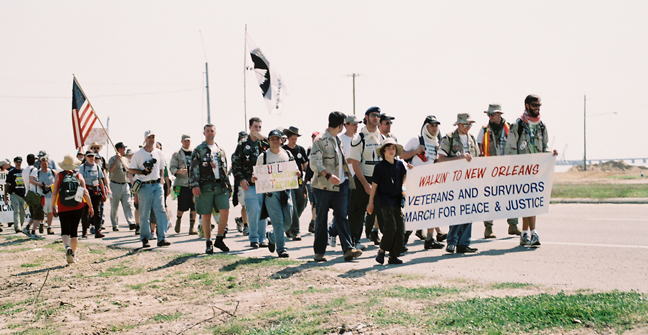
The antiwar GIs Today, there are echoes of the Vietnam experience in the protracted Iraq war -- including a growing protest movement in the military. Its trappings are starkly different this time. Rather than insubordination and violence, it has formed around a form-letter campaign, presumably conducted within the bounds of military regulations that restrict what soldiers are allowed to say. Last week, a group of current troops, with support from a handful of antiwar organizations, announced plans to petition Congress with a collection of "appeals for redress," which call for an immediate withdrawal from Iraq Salon
Thursday, November 2

Only 50 years left' for sea fish There will be virtually nothing left to fish from the seas by the middle of the century if current trends continue, according to a major scientific study.
... Bigger vessels, better nets, and new technology for spotting fish are not bringing the world's fleets bigger returns - in fact, the global catch fell by 13% between 1994 and 2003.
Historical records from coastal zones in North America, Europe and Australia also show declining yields, in step with declining species diversity; these are yields not just of fish, but of other kinds of seafood too.
BBC News
Wednesday, November 1
Global sex survey dispels misconceptions ... There is much greater equality between women and men with regard to the number of sexual partners in rich countries than in poor countries, the study found. For example, men and women in Australia, Britain, France and the US tend to have an almost equal number of sexual partners. In contrast, in Cameroon, Haiti, and Kenya, men tend to have multiple partners while women tend only to have one. This imbalance has significant public health implications. "In countries where women are beholden to their male partners, they are likely not to have the power to request condom use, and they probably won't know about their husbands' transgressions," said Wellings. The International Herald Tribune
Alcohol abuse most common killer of working-age Finnish men Alcohol abuse became the largest single cause of death among Finnish men aged 15 to 64, bypassing coronary heart disease as the main cause of death in the age group.
Alcohol-related deaths have risen by nearly one third in recent years. Among women, the figure has doubled within a decade. Helsingin Sanomat
Alcohol-related deaths have risen by nearly one third in recent years. Among women, the figure has doubled within a decade. Helsingin Sanomat

UK youths 'among worst in Europe ...Measured against German, French and Italian youngsters, British 15-year-olds are drunk more often and involved in more fights, and a higher proportion have had sex.... Britons are also more immersed in consumerism than American youngsters, the research claimed. BBC News

Substance in Red Wine Could Extend Life, Study Says (A) report, published electronically today in Nature, implies that very large daily doses of resveratrol could offset the unhealthy, high-calorie diet thought to underlie the rising toll of obesity in the United States and elsewhere, should people respond to the drug as mice do.
Resveratrol is found in the skin of grapes and in red wine and is conjectured to be a partial explanation for the French paradox, the puzzling fact that people in France to enjoy a high-fat diet yet suffer less heart disease than Americans. NY Times
Tuesday, October 31

'New' Europe Reunites With Its Old Demons
The West introduced market capitalism in central Europe immediately after the fall of the Berlin Wall. Those ruthlessly implemented neoliberal economic policies today have destabilized the region. .. Nearly 17 years after the fall of the Berlin wall, we witness the rise of nationalism, xenophobia, and anti-Semitism in the "new" Europe; those ghosts that have haunted the region historically are back again... World Press Org

Water Is Running Out: How Inevitable Are International Conflicts? The world's population is growing and water consumption is increasing, but water resources are decreasing. "The world is running out of water," stated Tony Clarke and Maude Barlow, activists and experts on water issues, in their article "Water Wars," published by the Polaris Institute in 2003. They said that by 2025, world population would increase to 2.6 billion more than the present day and water demands would exceed availability by 56 percent. People will live in water-scarcity areas, and disputes over resources are inevitable. World Press Org

Trick or Treat? For Many Britons, the Reply Is Neither ... It is ... a rude culture shock for a generation of older people whose need for a macabre fall festival was traditionally satisfied by Bonfire Night. That holiday is celebrated by building a fire around a homemade effigy of Guy Fawkes, the Catholic perpetrator of the failed plot to blow up Parliament in 1605, and shouting happily as it burns to a crisp. Fireworks are set off, sausages are eaten, and some people toss effigies of unpopular politicians on the fire for good measure. NY Times
Tuesday, October 24

Staying the course is no longer an option There are no good options left in Iraq. To those who have lived through the daily carnage wrought by organized criminals, sectarian militias and jihadist terrorists, the idea that the U.S. can prevent a full-scale civil war--let alone transform Iraq into a stable democracy--has been dead for months. The main question is, How long will it take for military officials in Iraq and policymakers in Washington to concede that the whole enterprise is closer to failure than success? Time By APARISIM GHOSH / BAGHDAD
Saturday, October 21
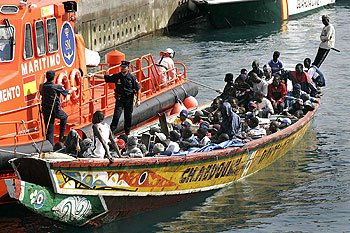
Fortress Europe Fights Immigration Helicopters, boats, and planes were sent by EU member states to control the Southeast European costal border. But the new anti-immigration operation does not stop there: they work hand in hand with three Senegalese patrol boats and one plane. Their mission is clear: scan the coasts of Mauritania, Senegal, and Cap Verde, intercept "cuyucos," small fishing boats that can carry up to 50 to 70 people, and take their passengers home safe and sound. Operation Hera II conducted by the European border agency Frontex, cost four million euros, 80 percent of which is paid by the EU. World Press
Subscribe to:
Posts (Atom)