Wednesday, November 1


Substance in Red Wine Could Extend Life, Study Says (A) report, published electronically today in Nature, implies that very large daily doses of resveratrol could offset the unhealthy, high-calorie diet thought to underlie the rising toll of obesity in the United States and elsewhere, should people respond to the drug as mice do.
Resveratrol is found in the skin of grapes and in red wine and is conjectured to be a partial explanation for the French paradox, the puzzling fact that people in France to enjoy a high-fat diet yet suffer less heart disease than Americans. NY Times

Tuesday, October 31


'New' Europe Reunites With Its Old Demons
The West introduced market capitalism in central Europe immediately after the fall of the Berlin Wall. Those ruthlessly implemented neoliberal economic policies today have destabilized the region. .. Nearly 17 years after the fall of the Berlin wall, we witness the rise of nationalism, xenophobia, and anti-Semitism in the "new" Europe; those ghosts that have haunted the region historically are back again... World Press Org

Water Is Running Out: How Inevitable Are International Conflicts? The world's population is growing and water consumption is increasing, but water resources are decreasing. "The world is running out of water," stated Tony Clarke and Maude Barlow, activists and experts on water issues, in their article "Water Wars," published by the Polaris Institute in 2003. They said that by 2025, world population would increase to 2.6 billion more than the present day and water demands would exceed availability by 56 percent. People will live in water-scarcity areas, and disputes over resources are inevitable. World Press Org

Trick or Treat? For Many Britons, the Reply Is Neither ... It is ... a rude culture shock for a generation of older people whose need for a macabre fall festival was traditionally satisfied by Bonfire Night. That holiday is celebrated by building a fire around a homemade effigy of Guy Fawkes, the Catholic perpetrator of the failed plot to blow up Parliament in 1605, and shouting happily as it burns to a crisp. Fireworks are set off, sausages are eaten, and some people toss effigies of unpopular politicians on the fire for good measure. NY Times

Tuesday, October 24


Staying the course is no longer an option There are no good options left in Iraq. To those who have lived through the daily carnage wrought by organized criminals, sectarian militias and jihadist terrorists, the idea that the U.S. can prevent a full-scale civil war--let alone transform Iraq into a stable democracy--has been dead for months. The main question is, How long will it take for military officials in Iraq and policymakers in Washington to concede that the whole enterprise is closer to failure than success? Time By APARISIM GHOSH / BAGHDAD

Saturday, October 21


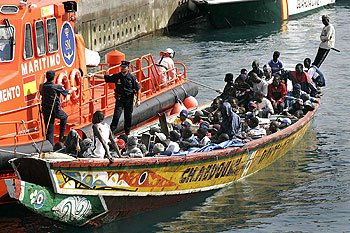
Fortress Europe Fights Immigration Helicopters, boats, and planes were sent by EU member states to control the Southeast European costal border. But the new anti-immigration operation does not stop there: they work hand in hand with three Senegalese patrol boats and one plane. Their mission is clear: scan the coasts of Mauritania, Senegal, and Cap Verde, intercept "cuyucos," small fishing boats that can carry up to 50 to 70 people, and take their passengers home safe and sound. Operation Hera II conducted by the European border agency Frontex, cost four million euros, 80 percent of which is paid by the EU. World Press

Thursday, October 19


The Death of the Dead Sea The Dead Sea has fallen more than 20 meters over the past 40 years. Studies by scientists at the University of Jordan have shown that the sea now drops one meter in depth each year. World Press Review
Iraq a 'catastrophic blunder The United States, the United Kingdom and Australia, having made such a catastrophic foreign and security policy blunder, are now trapped in a dilemma of their own making," he said. The Sydney Morning Herald

Wednesday, October 18


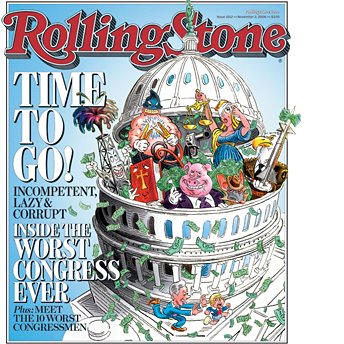
The Worst Congress Ever There is very little that sums up the record of the U.S. Congress in the Bush years better than a half-mad boy-addict put in charge of a federal commission on child exploitation. After all, if a hairy-necked, raincoat-clad freak like Rep. Mark Foley can get himself named co-chairman of the House Caucus on Missing and Exploited Children, one can only wonder: What the hell else is going on in the corridors of Capitol Hill these days? The Rolling Stone

Monday, October 16


Legendary underground New York club closes after 30 years Described in 1975 by music magazine NME as ‘a toilet, an impossibly scuzzy little club’ and by its own admission ‘a small, dirty, beer-soaked, dark pit,’ CBGBs nonetheless earned a reputation as sacred ground for the punk generation. Khaleej Times

Wednesday, October 11


McCain the neoconservative Is John McCain, the current frontrunner for the Presidency in 2008, a hawkish neocon likely to push regime change? Or is he an ideologically more moderate figure, a realist with deep-seated skepticism about committing American troops overseas? What kind of president, in other words, would McCain be? The Rolling Stone

Tuesday, October 10


John Lennon's Killer Denied Parole Again The panel remains concerned about the bizarre nature of this premeditated and violent crime," the board wrote in a one-page decision issued shortly after Chapman's appearance before the three-member panel at Attica. SF Gate

The strange thing being that while Lennon's fans will never forgive, pardon or show mercy to Chapman, John probably would. We miss you John!

Saturday, October 7

Paranoid in Tehran I don't know a single Iranian scholar, intellectual, organizer, or journalist whose life and pursuits have not been dampened by this current U.S. policy. Who is it actually benefiting? From where I sit, freedom has never seemed so remote. Time

Thursday, October 5


It's the coverup, stupid As Republican control of Congress in the midterm elections teeters on the precipice, the party leaders suddenly find themselves rediscovering the harsh reality of Richard Nixon's commentary on the Watergate scandal, that it's not the crime that kills you but the coverup. Salon

Wednesday, October 4

58 Percent of Americans: Bush Is Lying on Iraq In the Sept. 29-Oct. 2 (CNN) poll, 58 percent said the administration misled the public about how the war is going. In addition, 57 percent said the conflict has made the U.S. less safe from terrorism, indicating that Bush's central argument in defense of his policy isn't gaining traction with voters. Bloomberg

'Ancient light' takes Nobel Prize The CMB has been called the "echo" of the Big Bang - the event that created the Universe less than 14 billion years ago.
It is the radiation that formed when the Universe had cooled to such a degree that hydrogen atoms could exist. Before that time, scientists say, the Universe would have been so hot that matter and radiation would have been "coupled" - it would have been opaque. BBC

Tuesday, October 3


A Racial Rift That Isn't Black and White For centuries, the South has been defined by the color line and the struggle for accommodation between blacks and whites. But the arrival of hundreds of thousands of Hispanic immigrants over the past decade is quietly changing the dynamics of race relations in many Southern towns. NY Times

Monday, October 2


Violence not confined to Islam. Christian executes Girls in Paradise. A 32-year-old dairy truck driver killed at least three schoolgirls execution style and then shot himself dead after bursting into a one-room Amish schoolhouse in rural Pennsylvania... He was armed with an automatic handgun and a shotgun.. The Sydney Morning Herald
Liberty of thought and expression.
Robert Redeker, 52, a writer and high-school philosophy teacher who has been under police protection and in hiding with his family since the newspaper Le Figaro published his op-ed piece about Islam on Sept.19. Entitled "Faced with Islamist intimidations, what should the free world do?" Time

Sunday, October 1


Is the homeland where America's heart is? What kind of American are you? Red-state or blue-state? Secular humanist pinko or Bible-thumping loon? Tribe of Coulter or tribe of Franken? ..., one could say that old fires of tribal hatred (country vs. city, populace vs. elites) were rebuilt and carefully tended by politicians who could benefit from them. In that sense, what has happened in America in the last quarter-century is not altogether different from what has happened in the Balkans, the Middle East, Rwanda, Sudan and countless other exotic locations. The modalities of conflict are different, for the most part, and that's something to be grateful for. Salon


Song Search. Download. Listen. Vote!
Remember the last time you came upon a song you hadn't heard of before, a catchy tune that entered your head and refused to leave? The last time a fresh new sound seemed to open up the world just a little bit more? That's what Song Search is trying to find -- we want to unearth the greatest song you've never heard. Salon
The Literary Guide to the World? From Booker Prize winner John Banville on Ireland to acclaimed travel writer Tom Bissell on Vietnam, writers talk about the literature -- from fiction to history to memoirs -- that brings their beloved places alive. Salon

Saturday, September 30


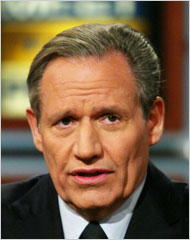
A Portrait of Bush as a Victim of His Own Certitude As this new book's title, (State of Denial), indicates, Mr. Woodward now sees Mr. Bush as a president who lives in a state of willful denial about the worsening situation in Iraq, a president who insists he won't withdraw troops, even "if Laura and Barney are the only ones who support me." (Barney is Mr. Bush's Scottish terrier.) N Y Times Books

Friday, September 29


Nato drawn into growing Russian spy row Georgian police continued to surround Russian army headquarters, renewing demands for the handover of a fifth officer accused of spying on Georgian military installations. However, Russia was defiant in its refusal to hand him over. Times


NATO to Broaden Military Operations in Afghanistan The agreement, endorsed at an informal two-day meeting of alliance defense ministers, would see some 12,000 US troops come under NATO control within Afghanistan's International Security Assistance Force within weeks. Deutsche Welle via World Press Review
Another zero-day threat hits Windows The Windows Shell bug is one of several flaws that are publicly known and for which exploit code is available, but which Microsoft has yet to patch. Cybercrooks are actively exploiting yet-to-be-fixed holes in PowerPoint, Word and IE, Microsoft has acknowledged. CNet News
Peek at NSA's Secret Reading List Written specifically for NSA employees, the articles listed in the online indexes date back as far as 1956. Stories include an analysis of the TRS-80 Model 1's password-encryption algorithm, accounts of how Soviet codes were broken, analyses of bad management techniques within the sprawling eavesdropping agency, and an insider's view of North Korea's capture of the spy boat U.S.S. Pueblo in 1968 Wired

Saturday, April 8

April 9, 2006
U.S. Study Paints Somber Portrait of Iraqi Discord

By ERIC SCHMITT and EDWARD WONG (New York Times)

WASHINGTON, April 8 — An internal staff report by the United States Embassy and the military command in Baghdad provides a sobering province-by-province snapshot of Iraq's political, economic and security situation, rating the overall stability of 6 of the 18 provinces "serious" and one "critical." The report is a counterpoint to some recent upbeat public statements by top American politicians and military officials.

The report, 10 pages of briefing points titled "Provincial Stability Assessment," underscores the shift in the nature of the Iraq war three years after the toppling of Saddam Hussein. Warnings of sectarian and ethnic frictions are raised in many regions, even in those provinces generally described as nonviolent by American officials.

There are alerts about the growing power of Iranian-backed religious Shiite parties, several of which the United States helped put into power, and rival militias in the south. The authors also point to the Arab-Kurdish fault line in the north as a major concern, with the two ethnicities vying for power in Mosul, where violence is rampant, and Kirkuk, whose oil fields are critical for jump-starting economic growth in Iraq.

The patterns of discord mapped by the report confirm that ethnic and religious schisms have become entrenched across much of the country, even as monthly American fatalities have fallen. Those indications, taken with recent reports of mass migrations from mixed Sunni-Shiite areas, show that Iraq is undergoing a de facto partitioning along ethnic and sectarian lines, with clashes — sometimes political, sometimes violent — taking place in those mixed areas where different groups meet.

The report, the first of its kind, was written over a six-week period by a joint civilian and military group in Baghdad that wanted to provide a baseline assessment for conditions that new reconstruction teams would face as they were deployed to the provinces, said Daniel Speckhard, an American ambassador in Baghdad who oversees reconstruction efforts.

The writers included officials from the American Embassy's political branch, reconstruction agencies and the American military command in Baghdad, Mr. Speckhard said. The authors also received information from State Department officers in the provinces, he said.

The report was part of a periodic briefing on Iraq that the State Department provides to Congress, and has been shown to officials on Capitol Hill, including those involved in budgeting for the reconstruction teams. It is not clear how many top American officials have seen it; the report has not circulated widely at the Defense Department or the National Security Council, spokesmen there said.

A copy of the report, which is not classified, was provided to The New York Times by a government official in Washington who opposes the way the war is being conducted and said the confidential assessment provided a more realistic gauge of stability in Iraq than the recent portrayals by senior military officers. It is dated Jan. 31, 2006, three weeks before the bombing of a revered Shiite shrine in Samarra, which set off reprisals that killed hundreds of Iraqis. Recent updates to the report are minor and leave its conclusions virtually unchanged, Mr. Speckhard said.

The general tenor of the Bush administration's comments on Iraq has been optimistic. On Thursday, President Bush argued in a speech that his strategy was working despite rising violence in Iraq.

Vice President Dick Cheney, on the CBS News program "Face the Nation," suggested last month that the administration's positive views were a better reflection of the conditions in Iraq than news media reports.

"I think it has less to do with the statements we've made, which I think were basically accurate and reflect reality," Mr. Cheney said, "than it does with the fact that there's a constant sort of perception, if you will, that's created because what's newsworthy is the car bomb in Baghdad."

In their public comments, the White House and the Pentagon have used daily attack statistics as a measure of stability in the provinces. Maj. Gen. Rick Lynch, a senior military spokesman in Baghdad, told reporters recently that 12 of 18 provinces experienced "less than two attacks a day."

Gen. Peter Pace, the chairman of the Joint Chiefs of Staff, said on the NBC News program "Meet the Press" on March 5 that the war in Iraq was "going very, very well," although a few days later, he acknowledged serious difficulties.

In recent interviews and speeches, some administration officials have begun to lay out the deep-rooted problems plaguing the American enterprise here. At the forefront has been Zalmay Khalilzad, the American ambassador, who has said the invasion opened a "Pandora's box" and, on Friday, warned that a civil war here could engulf the entire Middle East.

On Saturday, Mr. Khalilzad and Gen. George W. Casey Jr., the senior military commander in Iraq, issued a statement praising some of the political and security goals achieved in the last three years, but also cautioning that "despite much progress, much work remains."

Mr. Speckhard, the ambassador overseeing reconstruction, said the report was not as dire as its assessments might suggest. "Really, this shows there's one province that continues to be a major challenge," he said. "There are a number of others that have significant work to do in them. And there are other parts of the country that are doing much better."

But the report's capsule summaries of each province offer some surprisingly gloomy news. The report's formula for rating stability takes into account governing, security and economic issues. The oil-rich Basra Province, where British troops have patrolled in relative calm for most of the last three years, is now rated as "serious."

The report defines "serious" as having "a government that is not fully formed or cannot serve the needs of its residents; economic development that is stagnant with high unemployment, and a security situation marked by routine violence, assassinations and extremism."

British fatalities have been on the rise in Basra in recent months, with attacks attributed to Shiite insurgents. There is a "high level of militia activity including infiltration of local security forces," the report says. "Smuggling and criminal activity continues unabated. Intimidation attacks and assassination are common."

The report states that economic development in the region, long one of the poorest in Iraq, is "hindered by weak government."

The city of Basra has widely been reported as devolving into a mini-theocracy, with government and security officials beholden to Shiite religious leaders, enforcing bans on alcohol and mandating head scarves for women. Police cars and checkpoints are often decorated with posters or stickers of Moktada al-Sadr, the rebellious cleric, or Abdul-Aziz al-Hakim, a cleric whose party is very close to Iran. Both men have formidable militias.

Mr. Hakim's party controls the provincial councils of eight of the nine southern provinces, as well as the council in Baghdad.

In a color-coded map included in the report, the province of Anbar, the wide swath of western desert that is the heart of the Sunni Arab insurgency, is depicted in red, for "critical." The six provinces categorized as "serious" — Basra, Baghdad, Diyala and three others to the north — are orange. Eight provinces deemed "moderate" are in yellow, and the three Kurdish provinces are depicted in green, for "stable."

The "critical" security designation, the report says, means a province has "a government that is not functioning" or that is only "represented by a single strong leader"; "an economy that does have the infrastructure or government leadership to develop and is a significant contributor to instability"; and "a security situation marked by high levels of AIF [anti-Iraq forces] activity, assassinations and extremism."

The most surprising assessments are perhaps those of the nine southern provinces, none of which are rated "stable." The Bush administration often highlights the relative lack of violence in those regions.

For example, the report rates as "moderate" the two provinces at the heart of Shiite religious power, Najaf and Karbala, and points to the growing Iranian political presence there. In Najaf, "Iranian influence on provincial government of concern," the report says. Both the governor and former governor of Najaf are officials in Mr. Hakim's religious party, founded in Iran in the early 1980's. The report also notes that "there is growing tension between Mahdi Militia and Badr Corps that could escalate" — referring to the private armies of Mr. Sadr and Mr. Hakim, which have clashed before.

The report does highlight two bright spots for Najaf. The provincial government is able to maintain stability for the province and provide for the people's needs, it says, and religious tourism offers potential for economic growth.

But insurgents still manage to occasionally penetrate the tight ring of security. A car bomb exploded Thursday near the golden-domed Imam Ali Shrine, killing at least 10 people and wounding dozens.

Immediately to the north, Babil Province, an important strategic area abutting Baghdad, also has "strong Iranian influence apparent within council," the report says. There is "ethnic conflict in north Babil," and "crime is a major factor within the province." In addition, "unemployment remains high."

Throughout the war, American commanders have repeatedly tried to pacify northern Babil, a farming area with a virulent Sunni Arab insurgency, but they have had little success. In southern Babil, the new threat is Shiite militiamen who are pushing up from Shiite strongholds like Najaf and Karbala and beginning to develop rivalries among themselves.

Gen. Qais Hamza al-Maamony, the commander of Babil's 8,000-member police force, said his officers were not ready yet to intervene between warring militias, should it come to that, as many fear. "They would be too frightened to get into the middle," he said in an interview.

If the American troops left Babil, he said, "the next day would be civil war."

Eric Schmitt reported from Washington for this article, and Edward Wong from Baghdad. Jeffrey Gettleman contributed reporting from Hilla, Iraq, and Abdul Razzaq al-Saiedi from Baghdad.

Friday, March 3

Antarctica Cannot Replace Ice Loss


Antarctica Cannot Replace Ice Loss ...the findings suggest that a century of steady increases in global temperatures is altering the seasonal balance of the world's water cycle, in which new snow and ice neatly offset thaw and rainfall runoff every year to maintain the current level of the seas. LA Times

Wednesday, March 1

Consensus grows on climate change   A recent scientific report commissioned by the UK government warned that the world might already be fixed on a path that would begin melting the Greenland ice cap. That in turn would start raising sea levels throughout the world. BBC News By Roger Harrabin, Environment Correspondent
Writers issue cartoon row warning The writers say the violence sparked by the publication of cartoons satirising the Prophet Muhammad shows the need to fight for secular values and freedom. ...."It is not a clash of civilisations nor an antagonism of West and East that we are witnessing, but a global struggle that confronts democrats and theocrats." BBC News

Saturday, February 25

Did early humans socialise to avoid getting eaten?The work suggests that teamwork could have given earlyHomo – our human-like ancestors – an important advantage over their cousins Paranthropus, contributing to the latter’s extinction.New Scientist
Paintings by European masters stolen from Rio museum A spectacular robbery of art works by Picasso, Matisse, Monet and Dali marred the start of the Rio Carnival on Friday, which saw a slimmer than usual King Momo kick off festivities to feverish samba rhythms. From Merco Press as reported via Worldpress

Thursday, February 23


Who's isolating whom? America cannot preach democracy in Palestine, then chastise the winners, just as it cannot demand concessions from Hamas without Israel budging, too. It cannot bully dictatorial allies to reform, then always expect their support. And America cannot single out Iran on the nuclear issue, while ignoring Israel's nearby arsenal. It's like Dick Cheney hunting quail but shooting his friend instead, joked a Saudi columnist. ...What Egyptian officials fear is that too much pressure, too soon, could drive Hamas into further extremism. Instead of making threats, say the Egyptians, outsiders should bolster Palestinian institutions that are not run by Hamas, such as the presidency of Mahmoud Abbas, and give Hamas itself time to sort out a more practical, less ideology-bound position. ...
Economist

Saturday, February 18

The Abu Ghraib files Human-rights and civil-liberties groups have been locked in a legal battle with the Department of Defense since mid-2004, demanding that it release the remaining visual documents from Abu Ghraib in its possession. It is not clear whether the material obtained by Salon is identical to that sought by these groups, although it seems highly likely that it is. Salon


Now, this is something we and all other Nations should be protesting against. There is no freedom to torture. American's are not suppose to treat prisoners in this uncivilized manner. We can not be who we claim to be if we fail, under any circumstances, to live up to our ideas. Lately, the Bush administration has failed a lot and we find ourselves clearly in the wrong at Abu Ghraib and in Guantanamo. When did America take over the Hanoi Hilton?

Monday, February 6

Why the Cartoon Clash is Escalating. One of the reasons for the escalation is that Muslim and Western officials have deadlocked over how to resolve the original grievance. Muslim leaders insisted that the Danish paper had no right to publish images of the Prophet and demanded an apology; Danish officials, while expressing regret at the hurt feelings, have refused to apologize for what they see as the fundamental right of newspapers to freely publish their views. Time Online

Sunday, February 5


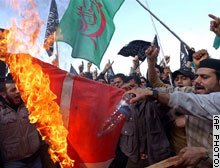
Muslim protesters target embassies. Demonstrators in Syria set fire to Norwegian and Danish embassies over a cartoon run in newspapers in those countries


Publish and Be Damned

IT WAS always intended to generate a debate about freedom of speech but, buried innocuously in the culture section of a newspaper, no-one guessed it would spark global protests, the burning of effigies and the unlikely cry of "Death to Denmark" Scotsman By ARTHUR MACMILLAN

The Last Word: Flemming Rose. Igniting More Than Debate

Why do you think Muslims are expressing such outrage now, when other religiously offensive cartoons have been published in the past?
"I think you have to separate this story into two parts. One part [is the debate inside Danish borders - that has been going on for four months. On the [one] hand, what does freedom of religion imply, what does respect for other people's feelings and religions imply? You have different points of view, and I think it's problematic if any religion - it doesn't matter if it's Islam, Christianity, Buddhism, any religion - tries to impose its own taboos on the public domain." Newsweek International Edition

Saturday, February 4

Lemkin's House, About Genocide's Ability to Endure, Begins U.S. Premiere in NYC

A play by Catherine Filloux about the man who coined the word "genocide," and his anguish over its toleration in the modern world, begins an Off-Off-Broadway run Feb. 3 at the 78th Street Theatre Lab.
Playbill via Yahoo

"The government's attempt at a middle-of-the-night transfer

A U.S. District Court judge temporarily blocked the federal government from transferring an American citizen to the custody of the Iraqi government, noting Friday that the move could place the prisoner at risk of torture and indefinite confinement.

By Michael Powell Washington Post

Friday, February 3

(is freedom really just another word for nothing left to lose?)


The concept of religious satire as political commentary is certainly not restricted to any one religion. Usually the humor (often ironic in nature) is not aimed at the religious figures or ideas, but rather at irrational zealots and/or those unworthy disciples that commit atrocities in the name of their respective religion. Here are some examples.


Thursday, February 2

Here are two of the, now infamous, twelve Cartoons. (The rest of the cartoons can be found at Michelle's Web site ), They were first published in Denmark, back in September 2005, but they have only recently caused such an International stir. I would just note that while all beliefs are deserving of respect, they should also be strong enough to tolerate humor and juxtaposition of ideas. A little tolerance goes a long way. Mind you tolerance is one thing that all cultures and religions could stand an large infusion of, otherwise we will just keep on heeding only the letter of the laws and continue to ignore the intent of all the prophets of all religions.


Monday, November 28

California Republican admits to taking $2.4 million in bribes I think I preferred Clinton's indiscretions to the Republican's corruption.

EU May Suspend Nations With Secret Prisons
By PAUL AMES, Associated Press Writer

11/28/05
BERLIN - The United States has told the European Union it needs more time to respond to media reports that the CIA set up secret jails in some European nations and transported terror suspects by covert flights, the top EU justice official said Monday.

Justice and Home Affairs Commissioner Franco Frattini also warned that that any of the 25 bloc nations found to have operated secret CIA prisons could have their EU voting rights suspended.

The Council of Europe _ the continent's main human rights watchdog _ is investigating the allegations, and EU justice official Jonathan Faul last week formally raised the issue with White House and U.S. State Department representatives, Frattini said.

"They told him: 'Give us the appropriate time to evaluate the situation.' Right now, there is no response," he said.

The CIA has refused to comment on the European investigation.

Frattini said suspending EU voting rights would be justified under the EU treaty, which stipulates that the bloc is founded on the principles of liberty, democracy, respect for human rights, fundamental freedoms and the rule of law, and that a persistent breach of these principles can be punished.

Clandestine detention centers would violate the European Convention on Human Rights.

Allegations that the CIA hid and interrogated key al-Qaida suspects at Soviet-era compounds in Eastern Europe were first reported Nov. 2 in The Washington Post. A day after the report appeared, Human Rights Watch said it had evidence indicating the CIA transported suspected terrorists captured in Afghanistan to Poland and Romania.

Poland President Aleksander Kwasniewski reiterated Monday that his country has never allowed the CIA to hold prisoners on its territory.

However, Kwasniewski said he was not the right official to comment on related allegations that CIA flights carrying terror suspects had secretly landed in Poland.

"No president is informed if some plane lands," Kwasniewski said.

Frattini said Romania's interior minister, Vasile Blaga, had assured him the allegations were untrue and that a base at Mihail Kogalniceanu _ used by American forces from 2001-03 to transport troops and equipment to Afghanistan and Iraq _ was not used as a detention center.

"It is very, very important to get the truth. It is impossible to move only on the basis of allegations," Frattini said.

Reports of secret CIA flights followed the allegations of secret prisons, as more and more countries have decided to open investigations into the issue. Frattini said if the flights took place without the knowledge of local authorities, they would be violations of international aviation agreements.

Other airports that might have been used by CIA aircraft in some capacity include Palma de Mallorca in Spain, Larnaca in Cyprus and Shannon in Ireland, as well as the U.S. air base at Ramstein, Germany, EU officials have said. Investigations into alleged CIA landings or fly overs have been launched in Austria, Denmark, Iceland, Norway and Sweden, and there have been unconfirmed reports in Macedonia and Malta.

Wednesday, November 16

DuPont Hid Chemical Risk Studies DuPont Co. hid studies showing the risks of a Teflon-related chemical used to line candy wrappers, pizza boxes, microwave popcorn bags and hundreds of other food containers, according to internal company documents and a former employee.

Five U.S. Marines killed in Iraqi firefight Sixteen insurgents were also killed in the fighting, part of Operation Steel Curtain, a U.S.-Iraqi military offensive aimed at clearing insurgents out of towns in northwestern Iraq.
November 16, 2005
Vietnam Archive Offers Parallel to War in Iraq

By THOM SHANKER, DAVID STOUT
and JOHN FILES
WASHINGTON, Nov. 16 - White House advisers convene secret sessions on the political dangers of revelations that American troops committed atrocities in the war zone, and whether the president can delicately intervene in the investigation. In the face of an increasingly unpopular war, they wonder at the impact on support at home. The best way out of the war, they agree, is propping up a new government that can attract feuding elements across a fractured foreign land.

With an obvious resonance to current events, the National Archives and Records Administration released 50,000 pages of previously classified documents from the Nixon administration today that reveal how all that president's men wrestled with issues that eerily parallel problems facing the Bush administration.

There are many significant differences between the wars in Vietnam and in Iraq - a point that senior Bush administration officials make at any opportunity. But in tone and content, the Nixon-era debate about the impact of that generation's war - and of war crimes trials -- on public support for the military effort and for White House domestic initiatives strikes many familiar chords.

As the Nixon administration was waging a war and trying to impose a peace in South Vietnam, it worried intensively about how the 1968 massacre at My Lai by American troops would hurt the war effort, both at home and in Asia.

My Lai "could prove acutely embarrassing to the United States" and could affect the Paris peace talks, Defense Secretary Melvin R. Laird warned President Richard M. Nixon. "Domestically, it will provide grist for the mills of antiwar activists," Mr. Laird said.

Documents show how the Nixon White House fretted over politics and perception, much as the current Bush White House has during the Iraq war, and that the Nixon administration feared that reports of the mistreatment of civilians could be ruinous to its image.

"The handling of this case to date has strictly observed the code of military justice," Henry A. Kissinger, then the national security adviser, wrote in a memo to the presidential aide H. R. Haldeman. Mr. Kissinger said a court-martial of Lt. William L. Calley Jr., who was implicated in the massacre and ultimately convicted, would alleviate press concerns about a cover-up.

Moreover, President Nixon believed that images could be changed, as the presidential aide John R. Brown III wrote to Mr. Kissinger. "Secretary Laird's press is a measure of the good things a one-time hard-liner can earn by playing the dove for the liberal press," Mr. Brown wrote on Jan. 14, 1970.

With so many academic studies, popular histories and memoirs on the bookshelf - and more than seven million pages of Nixon documents released since 1986 by the National Archives - historians combing over the files on Wednesday said they were more looking for golden needles in a haystack than mining a previously unknown vein of precious metals. The new release of documents included files on early American assessments of Israel's nuclear program, debates about supporting Pakistan during its war with India in 1971 and the superpower rivalry with Moscow.

Some of the Vietnam documents contain details on how the Nixon administration tried to prop up South Vietnam's president, Nguyen Van Thieu, behind the scenes while portraying him publicly as a courageous leader, as President Lyndon B. Johnson had done.

In language that resonates with the positions of the Bush administration with regard to building a new government in Baghdad, the Nixon White House said in May 1969 that it wanted to establish in Vietnam "procedures for political choice that give each significant group a real opportunity to participate in the political life of the nation."

"What the United States wants for South Vietnam is not the important thing," according to an internal White House planning initiative memo. "What North Vietnam wants for South Vietnam is not the important thing. What is important is what the people of South Vietnam want for themselves."

The papers illustrate, too, how as late as 1969 American leaders really did not know that much about the psychology of North Vietnam - or, for that matter, about sentiments in the South.

In March 1969, while the Paris peace talks were under way, American officials worried about how strongly to react to a rocket attack on Saigon. Secretary of State William P. Rogers cabled United States diplomats on the decision not to retaliate militarily against the North.

"Plainly, we shall need to have the most careful and continuing readings of the South Vietnamese temperature," Mr. Rogers wrote, reflecting Washington concerns that the Saigon government would suspect it was being sold out.

Around that time, the State Department suggested that the American negotiator Henry Cabot Lodge soften his language in conveying Washington's displeasure to the Hanoi delegation. "We prefer this language not because it is less ambiguous than the original version but, on the contrary, because it is more ambiguous - and hence more flexible - as to our response," a State Department cable said.

That July, President Thieu fussed over Washington's editing of a speech he was to make recounting all the concessions that had been made to the Communists and calling again for general elections. A secret State Department wire to Saigon and Paris said an aide to Mr. Thieu, in describing his boss's annoyance, "used a phrase which, translated into English, comes out like 'Secretary Rogers has deflowered my speech.' "

President Nixon praised the July 11 speech as "a comprehensive, statesman-like and eminently fair proposal for a political settlement in South Vietnam."

The documents show an internal debate in Washington over what effects the death of Ho Chi Minh, in September 1969, would have. Mr. Kissinger told the president that Ho's death would hurt North Vietnam's morale but would probably not soften its resolve. But a State Department cable to its diplomats around that time, when the department was headed by Mr. Kissinger's rival, Mr. Rogers, had a different perspective. "We are, of course, uncertain ourselves of consequences of Ho's death," it read in part. "We are handicapped in our own analysis by paucity of good intelligence information on North Vietnamese intentions and internal politics."

During the summer and fall of 1969, a great effort was made by the Nixon White House to intervene in a military investigation of a group of Army Special Forces troops who had been accused of killing a suspected double agent in Nha Trang.

In a memorandum to Bryce Harlow, a Nixon aide, on Sept. 26, 1969, Mr. Kissinger counseled him on how to deal with the concerns of Congress.

"The main substantive point you should make," Mr. Kissinger wrote, "is that the president is very concerned about the long-term implications of this case and that he is most anxious to dispose of it in a way which will do the least damage to our national security, the prestige and discipline of our Armed Services and to preserve our future freedom of action in the clandestine area."

"This is clearly a sign of things to come - and we are really going to be hit," Mr. Haldeman wrote to Mr. Kissinger, urging a quiet resolution. "Anything we can do - even at this late date?"

On Sept. 29, the Army secretary, Stanley R. Resor, said that the Central Intelligence Agency, "though not directly involved in the alleged incident," had declined to let its personnel testify.

"It is my judgment that under these circumstances the defendants cannot receive a fair trial," Mr. Resor said. He ordered the charges dismissed.

The suspected double-agent, Thai Khac Chuyen, had been employed by the Special Forces as part of an intelligence operation in Cambodia. After being held in solitary confinement, he was given what one of the accused soldiers, who later confessed to some involvement, called "a wet disposal."

It was alleged that eight soldiers had drugged Mr. Chuyen, shot him and weighted him with tire rims before dropping him into Nha Trang bay.

In October 1969, after all charges had been dropped, the government paid Mr. Chuyen's widow a $6,472 "missing-person gratuity."


Copyright 2005 The New York Times Company

Saturday, September 4

Aljazeera's Iraq correspondents speak out Iraqi officials want neutral coverage from their point of view. They blame us for not presenting the after-Saddam era achievements. But when we ask them what their achievements are, we do not get clear answers. Aljazeera (English)
Dozens killed in Iraq as violence surges Dozens of Iraqis have been killed and scores wounded in attacks in northern Iraq and Baghdad. Three Iraqi policemen were killed on Saturday afternoon south of Baghdad, an interior ministry spokesman said. World Press Review

�
Iraq extends ban on al-Jazeera TV Iraq's interim government has indefinitely extended a month-long ban on Arabic TV news channel al-Jazeera. BBC Newsm UK edition

Three Days of Terror for Russian Child Hostages
At first, they treated us okay and gave us water," Azamat Ktsoyev, 14, said of the Chechen separatists who stormed into the building on Wednesday during festivities marking the first day of school. But after that they started to treat us like dogs, shooting above our heads and beating people. Yahoo News

Tuesday, August 3

Bush puts Country on World Trade Center Alert in 2004 or If Paul Revere had been in the Bush administation we would all still be British The Bush administration was forced into the embarrassing admission yesterday that "new" intelligence about al-Qa'ida's plans to attack US financial institutions - information that led to an official alert and a slew of fresh security measures - was up to four years old and predated the 11 September attacks. The Independent

Saturday, July 31

NEWSWEEK POLL: DEMOCRATIC CONVENTION 2004 -- Kerry/Edwards Leads Bush/Cheney 52 to 44 Percent Looking at crossover voters from the 2000 election, 92 percent of Gore voters in 2000 support Kerry (5 percent say they will vote for Bush and 3 percent is undecided); 84 percent of Bush voters say they plan to vote for the president again (four percent of Bush 2000 voters are undecided, 10 percent say they will vote for Kerry and 2 percent for Nader). Yahoo Finance

Friday, July 30

Bush is put on the spot as growth falls to 3% U.S. economic growth slowed more abruptly than expected in the second quarter, as higher energy prices prompted consumers to slow their spending. The news appeared to undermine President George W. Bush's efforts to show solid economic growth as a validation of his administration's policies. International Herald Tribune

Thursday, July 29

Kerry pledges to fight for America
In a clear swipe at President Bush, he said he would bring back what he called the country's time-honoured tradition of never going to war because it wanted to but only "if it had to". BBC News UK Edition
The race to catch the iPod Apple has come up with a product of beauty and, at the same time, changed an entire industry. It has also rejuvenated its own financial fortunes�a more-than-doubling in year-on-year sales of the iPod has contributed to a 30% jump in revenue in the latest quarter, to $2 billion. But Apple-watchers, even its most loyal fans, have been here before. It did the same to personal computing, with the Apple Mac. But Microsoft came along, copied it, and squashed it. Apple will have to fight hard to ensure that doesn�t happen again. The Economist
Africa intervenes to stop Darfur�s slaughter As its observers report further atrocities in the Darfur region of Sudan, the African Union says it may send troops to disarm the Arab militiamen there, in what would be the AU�s first military intervention in a member state. The United Nations is expected shortly to discuss possible sanctions against Sudan The Economist

Tuesday, July 13

Bush Insists He Has Made America Safer (and the Nazi's made the trains run on time) Faced with polls that show many believe the terror threat against them has increased due to the Iraq war, Bush argued that wars against Iraq, Afghanistan (news - web sites) and al Qaeda have made them safer, as has diplomacy that led Libya to surrender its weapons of mass destruction programs. Yahoo News
I write badly, therefore I am a would-be terroristSuddenly a light went on in my head. I remembered the passenger on my left leaning forward in his seat as I scribbled while we waited for takeoff. Seconds later, he'd clambered hastily over me without apology to make his way to the front of the plane. I'd assumed intestinal complications, but now that I thought about it, he hadn't used the bathroom. He'd spoken briefly with the flight attendants and returned to his seat. As the security woman looked at me, I now realized the passenger had been about as interested in my puzzling prowess as she was. Houston Chronicle
Bush Insists He Has Made America Safer (and the Nazi's made the trains run on time) Faced with polls that show many believe the terror threat against them has increased due to the Iraq war, Bush argued that wars against Iraq, Afghanistan (news - web sites) and al Qaeda have made them safer, as has diplomacy that led Libya to surrender its weapons of mass destruction programs. Yahoo News

Monday, July 12

America's Chechnya....it has something of Vietnam in its asymmetric nature, something of Algeria in its tactical quality, and there are probably some lessons to be learned from all sorts of comparisons with other wars from history. To make a contemporary comparison, in its domestic political dynamic, and to a degree in its expeditionary, overwhelming-force military technique, U.S. President George W. Bush's venture in Iraq can be compared with Russian Federation President Vladimir Putin's war in Chechnya. World Press Review
U.S. Elections 2004 Comment and analysis from the world's press on the upcoming U.S. elections World Press Review

Philippines to pull out of Iraq Philippines to pull out of Iraq World Press Review
Congo uranium mine collapses Part of a uranium mine has collapsed in eastern Democratic Republic of Congo, killing at least nine people. BBC News

Sunday, July 11

High prices for gas, milk push struggling families to brink Last month, the Consumer Price Index, the government's most closely watched inflation barometer, posted its largest increase in more than three years, the Labor Department said. The main culprits were gasoline--which has dipped in recent days but still remains about 30 percent higher than a year ago--and galloping food costs, especially dairy products, which jumped at the most rapid pace since World War II. Chicago Tribune

Will U.S. Foreign Policy Increase Terrorism? As long as American foreign policy remains the same and the Palestinian issue is left unresolved, the U.S. war on terror will increase terrorism by 100 percent, said Lebanese Shiite Muslim leader Grand Ayatollah Mohammed Hussein Fadlallah World Press Review
Polls show a growing progressive electorateNobody thinks it will happen without incredibly hard work against an ugly and well-financed Republican campaign of fear, and victory may still depend on tight votes in swing states. But voters are expressing deepening awareness that America is on the wrong track and growing disapproval of Bush�s performance on the war and the economy. In These Times

Friday, July 9

Joyce letter smashes sale record
An erotic letter sent by author James Joyce to his wife has fetched a record �240,800 at auction in London. BBC News
Brando's last role: an evil old lady Marlon Brando fulfilled a lifelong ambition in his final film: to play an old lady. True to his Method training, the actor donned a blond wig and full drag for the part, even though the film was animated. Guardian
Bush's helping hands: Media scrubs president from Ken Lay coverage a review of mainstream press coverage since news of the Lay indictment first broke Wednesday afternoon indicates most news outlets, minus the San Francisco Chronicle and a handful of others, have completely downplayed the Bush connection, or simply ignored it all together. That, of course, is good news for the White House, which now wants nothing to do with the disgraced energy executive, once on the short list to be in Bush's cabinet. Salon

Thursday, July 8

Big brother in the bookstore Many legislators on Capitol Hill will own up to supporting the Patriot Act, even with some of its more noxious provisions, in a 9/11-induced haze. But there are a few politicians in Washington -- especially those surrounding President Bush -- who continue to insist that, somehow, keeping track of what books ordinary Americans check out of the library will stop the next al-Qaida plot. Bush himself seems intent on keeping every part of the law on the books, a fact underscored yesterday when the White House threatened to veto a spending bill if it contained amendments weakening the government's power to spy on Americans' reading habits. Salon

Ultimate dot-com survivor faces new challenges WebMD, a health care company forged by two high-profile entrepreneurs at the height of the dot-com boom, is fabulously successful by one important measure: It's still here. CNET News
Turbulent skies Innovative and bold low-cost carriers have transformed the airline industry on both sides of the Atlantic. But are they now doomed to lose their momentum?
The Economist
The big one After more than two years of investigation, prosecutors have filed charges against Kenneth Lay, the former chairman of Enron. But though the bankrupt energy-trading company has become a synonym for corporate fraud, �Kenny Boy� may yet wriggle off the hook. The Economist

Thursday, May 13

American shame; Islamist snuff movies It's a tough call whether Abu Musab al-Zarqawi�the Jordanian "militant" who is reportedly responsible for the videotaped butchery of Nicholas Berg�is more stupid than he is brutal, or whether he is a bigger monster than he is a fool. Zarqawi's own nauseating videotape makes the case for his indescribable brutality. Reason
So much for the moral president Pentagon Admits Iraq Methods Violated Geneva Rules Yahoo News

Monday, May 10

A failure of leadership at the highest levels Around the halls of the Pentagon, a term of caustic derision has emerged for the enlisted soldiers at the heart of the furor over the Abu Ghraib prison scandal: the six morons who lost the war. The Army Times
Connect music store an 'embarrassment' to Sony Rob Pegoraro of The Washington Post says that Sony's Connect music store, which was launched on Tuesday, is "an embarrassment to the company that gave the world the Walkman." Pegoraro calls Sony's Sonic Stage, the software you must use to download and manage your purchases, "a bloated, bug-ridden beast of a program. Mac Minute
(Bush continues errors of his way) and backs 'superb' defence chief Mr Bush's praise of Mr Rumsfeld came amid growing calls for the defence secretary to resign over the scandal. BBC News

Newspapers See Danger in Text Messaging
International editors and publishers warned Friday that nontraditional communications � such as cell phone text messages � are rapidly outflanking radio, television, and print media because of their immediacy and proximity to the public.
Yahoo News

Tuesday, April 20

Where has time gone. I have spent all my efforts at my other sties and have not been back here since November. (Imagine all the nonsense W has done in the ensuing five months) Hopefully parties interested in news and admitted fiction (as opposed to W's pre-ported truths) have followed some of the links. Wildmagic7 or Now Just One Minute
Albert Einstein's theory of general relativity put to the Space test The idea of the mission was first proposed in 1959, but the project has been aborted and delayed many times due to budget reviews. BBC News
The Salon Interview: Neal Stephenson The rivalries between the various scientists you write about are so bitter, it's surprising even to someone who already knows that science isn't this Olympian, rational activity totally removed from human pettiness. ( By Laura Miller} Salon
Schwarzenegger promises California 'Hydrogen Highway' by 2010 Schwarzenegger signed the order after driving around a university campus in a Toyota Highlander propelled by a clean-burning hydrogen engine. The University of California at Davis is the site for one of America's most advanced centers for the study of alternative transportation systems. Salon

Saturday, November 15

Granny gorilla knows best on baby-care A captive female gorilla has been spotted teaching her daughter how to tend to her newborn. Gorilla mothers are often seen teaching their young to walk and climb, but primatologists believe this is the first report of a mother instructing her daughter on baby care. NewScientist
A Scary Afghan Road 1. In the two years since the war in Afghanistan, opium production has:

(A) virtually been eliminated by Hamid Karzai's government and American forces.

(B) declined 30 percent, but eradication is not expected until 2008.

(C) soared 19-fold and become the major source of the world's heroin.

2. In Paktika and Zabul, two religiously conservative parts of Afghanistan, the number of children going to school:

(A) has quintupled, with most girls at least finishing third grade.

(B) has risen 40 percent, although few girls go to school.

(C) has plummeted as poor security has closed nearly all schools there.

The correct answer to both questions, alas, is (C). (New York Times) via Common Dreams

Wednesday, November 12

U.S. Troops More Hostile With Reporters With casualties mounting in Iraq (news - web sites), jumpy U.S. soldiers are becoming more aggressive in their treatment of journalists covering the conflict.
Media people have been detained, news equipment has been confiscated and some journalists have suffered verbal and physical abuse while trying to report on events. Yahoo News
Global warming, wine quality linked Global warming may become a worldwide catastrophe, but at least the wine should be good. Seatle Post Intelligencer

Tuesday, November 11

Conversations With Homeless Vets Living or working in San Francisco, you can't avoid the homeless. Near our office at Fifth and Mission, I walk past many homeless people every day, yet I never talk to them. And, whenever I read about them, it's about the homeless as an issue, not about individual human beings with unique lives.

For many of them, those lives have included service in the military. According to the National Coalition for Homeless Veterans, 33 percent of all homeless men are veterans, as is nearly one-fourth of the homeless population in general.

As the United States ships thousands of troops worldwide to fight the "war on terror," I find myself thinking about what joining the military and fighting for one's country really means. I am fascinated with warriors, probably because as a woman in America, it's an experience I'll probably never have. I wonder particularly what it's like to have served your country and now be living destitute on the streets.

I decided to find out. Over the last few weeks, I spoke with several homeless vets who I met through Dave Hanzel at St. Anthony's Dining Room in downtown San Francisco. Some of them saw combat duty, and others didn't.

I'm not here to weigh in on policy about homeless people -- what care or cash they should be given -- as much as I wish to give a glimpse into their lives. I hope you find the interviews compelling for no other reason than that they reinforce the idea that we are all connected in our humanity. Human life is fragile. We all suffer. And, yet, for some inexplicable reason, most of us carry on.

I've done my best to verify that what the people I talked to told me has some basis in fact. But, with the homeless, it's hard to identify people with certainty and even more difficult to track them down to check the facts. I leave it for you to decide for yourselves. I may even include some obvious tall tales because they're so entertaining. (By Amy Moon, Features Editor, SF Gate ) SF Gate

Monday, November 10

Age boom hastens the quest to live longer, better lives
Zerline Aronin is blind in one eye and uses a walker for balance even inside her one-bedroom Capitol Hill apartment.
But she still cooks breakfast every morning � oatmeal with fresh fruit � before showering and making up the bed without a wrinkle.
By midday, she's out the door in sensible shoes, pushing her walker to beat the stoplight at a busy Madison Street intersection. It's a few blocks to feed a flock of waiting pigeons, then a few more to the grocery or over to the fire station to have her blood pressure checked. On an occasional Saturday she sets out to synagogue around the corner.
That's several miles a week � not bad for a 102-year-old. By Marsha King ), Seattle Times

Monday, October 27

Bombings Plunge Iraqi Capital Into Chaos at Start of Ramadan �BAGHDAD, Iraq - A series of suicide bombings shook Baghdad early today, including an attack on the offices of the International Committee of the Red Cross and blasts at four Iraqi police stations that punctuated two days of bloody violence in this capital city. Truthout
Civil Rights Groups Blast Bush Court Nominee Civil rights groups, which have been pressing Senate Democrats to filibuster a series of important judicial nominations by President Bush, are now mobilizing opposition to the latest nominee, California Supreme Court justice Janice Rogers Brown.

Brown, nominated to the U.S. Court of Appeals for the District of Columbia Circuit, has also come under fire from other sources, including the New York Times, which on Saturday described her nomination as "among the very worst ...of the many unworthy judicial nominees President Bush has put forward." The D.C. Circuit is widely considered to be the second-most important court in the United States, after the Supreme Court itself. (by Jim Lobe, One world Net via Common Dreams

Thursday, September 11

Ground zero, 2004 "The White House has used Lower Manhattan as a campaign springboard for the president's reelection in 2004, and nothing else," says Margarita Lopez, a Democratic city councilwoman who represents that part of Manhattan. "I was willing to give them the benefit of the doubt months ago, but no more. Dealing with this issue has been partisan from beginning to end." Salon

New York City, Two years on Poll after poll shows New Yorkers are still haunted by the attack, and wary that another might follow. Police believe they thwarted a bombing of the Brooklyn Bridge, and large battalions of cops are still often sent into the subways to ward off possible attacks. There was widespread relief last month when the electrical blackout was found to be merely that. The Economist


The Iraqis don't particularly want the UN to manage their money or their security IT IS not just the Americans who question the role of the United Nations in Iraq. The UN questions it itself�and so do the Iraqis. Since May, the World Food Programme has shipped the equivalent of a 25-tonne truck of wheat every minute of every day. On the walls of the Baghdad Convention Centre, home to both the American army's information centre and the American consul, hangs a UN tender for the supply of 841 square metres of glass, part of its emergency assistance programme to Iraq. But the UN's job, say many of its staffers, is to help the world's most vulnerable, not prop up America's occupation of Iraq. The Economist
Two years on ... Wishful thinking is not a policy ONE of President George Bush's best phrases, deployed between the atrocities of September 11th and the American invasion of Afghanistan later that year, was that the effort to win the battle that al-Qaeda's suicide hijackers had launched would consist not of one big victory but rather of �the patient accumulation of successes�. Not everyone, either then or during the run-up to the invasion of Iraq last March, agreed that America's behaviour was truly patient. No matter: it was certainly resolute and pretty relentless, and only the churlish or blinkered could deny that successes were indeed being accumulated. Now, however, on the second anniversary of those terrible events in New York, Washington and Pennsylvania, things feel different. �The hapless accumulation of failures� is sounding a more appropriate line. The Economist


The Prewar Intelligence Imbroglio - A Tale of Two Leaders Were politics on either side of the Atlantic burdened with such notions as shame, integrity, or even results, both British Prime Minister Tony Blair and American President George Bush would be struggling for their political survival. Both lied to their electorates in order to prosecute an illegal war against the will of the international community. Neither has a clue how to rebuild the country they have just destroyed, other than with more force, which is resulting in greater loss of life on both sides. World Press Review
Chile commemorates in the pain the inversion of Allende September 11, 1973, a military junta reversed the government of El Salvador Allende and Chile settled during a long time of dictatorship. Arrests, tortures, assassinations: three thousand people died or disappeared during the Pinochet years. Thirty years later, Chilean president Ricardo Lagos, Socialist, chose to commemorate officially the inversion of El Salvador Allende "to show in the world how much Chile changed since the return of the democracy". But this celebration is strongly criticized by the partisans of the Pinochet General, the opposition of right-hand side and the allies of the Christian democracy. The questions of the humans right and of repairs to the victims and to their families remain sensitive. Many denounces "assured immunity" with the of torture ones.
LeMonde
Baghdad blogger: Salam Pax live online on September 12 International media attention focused on Iraq in the run-up to the 2003 Gulf war. But with satellite TV banned and access to the internet heavily censored under the Saddam regime, voices from within the country were few and far between.

Into this vacuum stepped a 29-year-old resident of Baghdad, calling himself Salam Pax. His weblog documenting life in the Iraqi capital before, during and after the US-led invasion achieved world renown, and he now also writes a regular column in the Guardian.
On Friday Salam Pax will be live online on Guardian Unlimited. You can post your your questions and comments for him now, email questions to editor@guardianunlimited.co.uk and join the discussion live at 1.45pm on Friday September 12 Guardian Unlimited
3 Nations Offer Iraq Proposals France and Germany, in a joint proposal, have offered to recognize an Iraqi transition government and endorse a U.S.-led multinational force if the U.S. hands over most of its control over the political transition to the U.N. and the interim Iraqi leaders. Russia presented a separate proposal closer to U.S. and British ideas. LA Times

Friday, July 4

Dell finally stops using prison labor to dismantle and recycle computers. Last week, the Silicon Valley Toxics Coalition, an environmental group in California, accused Dell of running a "primitive" recycling system that exposed inmates to dangerous chemicals as they took apart computers and plucked out the reusable parts. CBS News